
The 21st century is witnessing a global shift in how power is exercised. While democratic ideals remain widely celebrated, authoritarian systems are gaining ground, often by promising efficiency, stability, and rapid development. For ordinary citizens, this is no longer a theoretical debate. It affects jobs, freedoms, security, and dignity.
Across the world, a debate between democracy and autocracy has serious implications for economic policies and influences the daily lives of billions of people. People want a democratic system that favors them in many ways. It gives them a complete sense of authority to choose their preferred representatives in elections. Voting is the public’s power to protect their own rights.
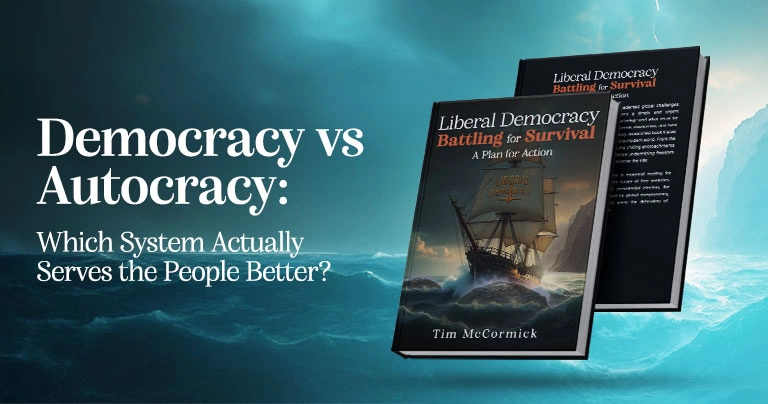
However, politicians often favor autocratic systems because centralized power benefits them through control, authority, and prolonged rule. As Tim McCormick highlights in Liberal Democracy: Battling for Survival – A Plan for Action, many modern states continue to hold elections and claim democratic legitimacy while quietly weakening courts, silencing dissent, and concentrating power, by creating democracies in name but not in practice. This erosion does not happen overnight, but gradually, making it harder for citizens to recognize until their freedoms are already diminished.
A fundamental question, therefore, persists: which political system is best for the people? This blog aims to explore that question by examining democracy and autocracy through the lens of rights, accountability, economic opportunity, and human dignity.
Defining the Systems: Democracy VS Autocracy Explained
What Is Democracy?
At its core, democracy is a system in which political authority originates from the people. Citizens choose their leaders through free and fair elections, enjoy legal equality, and possess fundamental rights such as freedom of speech, association, and belief. It provides people with peace and justice, which they deserve to live in a country. Democracy works on an equal basis and does not discriminate against anyone for any reason.
Modern democracies take many forms, such as:
- Liberal democracies, emphasizing individual rights and checks on power
- Electoral democracies, focused primarily on voting processes
- Social democracies, combining political freedom with social welfare
Core Principles of Democracy
Democracy is a system that only comes from public consent. It is built on the following core principles, which serve as its foundation and ensure it stands firmly.
1. Popular Sovereignty
Popular sovereignty means that the people are the ultimate source of political authority. Governments govern with the consent of the governed, not by divine right or force. This principle recognizes citizens as stakeholders in the state, entitled to influence public decisions and hold leaders accountable. Laws and policies derive legitimacy only when they reflect, directly or indirectly, the will of the people.
2. Free and Fair Elections
Elections are the primary mechanism through which popular sovereignty is expressed. In a democracy, elections must be:
- Free: voters can choose without coercion or intimidation
- Fair: all votes carry equal weight and results reflect genuine public choice
- Competitive: multiple parties or candidates can contest for power
- Regular: leaders face periodic renewal of their mandate
Elections allow peaceful transfer of power and provide citizens with a nonviolent means to remove ineffective or abusive leaders.
3. Rule of Law
The rule of law ensures that no one is above the law, including elected officials. Laws are applied equally, enforced by independent courts, and designed to protect fundamental rights. This principle prevents democracy from degenerating into mob rule or authoritarianism by placing clear limits on power and safeguarding individual liberties.
Together, these principles distinguish democracy from systems where power is imposed rather than granted. While democracies may be slow, imperfect, and contentious, their defining strength lies in treating citizens not as subjects, but as participants in their own governance.
What Is Autocracy?
Autocracy concentrates power in the hands of a single ruler or a narrow elite. Elections, if they exist, are controlled. Dissent is restricted. The media is often state-influenced or censored. It follows one-party control with no role of opposition in the parliament. These politicians are mostly connected with the army to extend their period of regime.
They give extra favor to the military establishment to sustain in power for longer. In their era, the value of opposition comes to zero, and nobody listens to them. Rulers never take the public for granted and do not fulfill their expectations. They apparently do not create roadblocks for anyone, but they still hold their authority in everything.
Autocratic systems include:
- Personal dictatorships
- One-party states
- Military regimes
Their legitimacy is often justified by promises of stability, national strength, or economic progress. Rather than consent, they rely on control, whether through law, surveillance, patronage, or coercion.
The following are the defining characteristics of autocracy:
· Centralized Power
In an autocracy, decision-making authority is highly centralized. A single ruler, such as a dictator, monarch, or party leader, or a narrow group of elites, exercises control over the executive, legislative, and often judicial functions of government. This concentration of power allows for rapid decision-making but eliminates meaningful checks and balances.
· Limited or Absent Political Participation
Citizens typically have little to no real influence over leadership selection or policy decisions. Elections, if held, are tightly controlled and lack genuine competition. Political opposition is often restricted, marginalized, or criminalized, ensuring that power remains within the ruling circle.
· Weak Accountability
Because leaders are not accountable to the public through free elections or independent institutions, accountability is internal rather than public. Loyalty is rewarded, dissent is punished, and corruption often flourishes in the absence of transparency and oversight.
· Control Over Information and Dissent
Autocratic systems commonly regulate media, restrict freedom of speech, and suppress dissent to maintain authority. Control of information helps shape public narratives and prevent challenges to the ruling elite, often at the cost of individual freedoms and civic trust.
In essence, autocracy prioritizes order, control, and efficiency over participation and freedom. While it may deliver stability or rapid action in the short term, its heavy reliance on centralized power makes it vulnerable to abuse, stagnation, and sudden collapse when leadership fails or legitimacy erodes.
How Do We Measure Serving the People?
To fairly compare democracy and autocracy, we must move beyond ideology and define criteria that matter to ordinary citizens:
1. Economic Opportunity And Prosperity
In democratic systems, economic opportunity is typically supported by transparent rules, enforceable property rights, and relatively predictable policies. Independent courts and regulatory institutions help create an environment where individuals can start businesses, invest, and compete without needing political connections.
While democracies often struggle with inequality and policy gridlock, they tend to generate broader access to opportunity over time, allowing social mobility through education, entrepreneurship, and open markets.
In autocratic systems, economic prosperity is frequently driven by centralized planning and state-directed investment. Such systems can mobilize resources quickly, build large-scale infrastructure, and push rapid development, particularly in the early stages of growth.
However, access to opportunity is often uneven. Economic success may depend heavily on loyalty to the ruling elite, personal connections, or proximity to power. Without transparency or independent oversight, corruption can distort markets and limit upward mobility for ordinary citizens.
2. Freedom And Human Dignity
Freedom is considered a fundamental right in democratic societies, rather than a privilege granted by the state. Citizens generally enjoy freedom of speech, belief, assembly, and association, allowing them to express opinions, criticize leaders, and organize around shared interests.
These freedoms affirm human dignity by acknowledging individuals as autonomous moral agents, not merely subjects of authority. Even when democracies fall short through discrimination, unequal enforcement, or political polarization, the underlying principle remains that rights belong to the people and can be defended through law.
Freedom is tightly constrained and conditional in autocratic systems. Expression that challenges the ruling authority is often restricted, monitored, or punished. Public conformity is encouraged, while dissent is portrayed as disloyal or dangerous.
Although some citizens may experience day-to-day stability and personal safety, this security is fragile because it depends on compliance rather than rights. Without legal protections, individuals have little recourse when power is abused.
3. Accountability and Corruption Control
Accountability and corruption control are central to whether citizens can trust their government. In democratic systems, accountability is built into the architecture of governance. Leaders are answerable to the public through regular elections, independent courts, legislative oversight, and a free press.
When corruption occurs, investigative journalism, opposition parties, and civil society organizations can expose wrongdoing and pressure institutions to act. While democracies are not immune to corruption, they provide lawful mechanisms to detect, punish, and correct abuses of power. Importantly, leaders can be removed without violence when trust is broken.
Whereas, in autocratic systems, accountability is limited and largely internal. Leaders are not meaningfully answerable to the public, and oversight bodies typically answer to the same authority they are meant to monitor.
Corruption is often tolerated or even incentivized as a tool for maintaining elite loyalty. Without transparency or independent enforcement, abuses of power are concealed rather than corrected, and whistleblowers face severe personal risk.
Economic Performance: Growth, Equity, and Sustainability
The benefits of democracy over autocracy are evident in the way democratic systems promote strong property rights, independent courts, transparent regulations, and competitive markets. These foundations create a stable and predictable environment that encourages entrepreneurship, drives innovation, and supports long-term investment. As a result, many of the world’s wealthiest and most innovative economies have historically developed under democratic governance, where the rule of law and open markets allow individuals and businesses to thrive.
However, while the benefits of democracy over autocracy are significant, democracies also face notable challenges. Political polarization can lead to policy gridlock, slowing decision-making and reform. Short-term electoral incentives may cause leaders to focus on immediate popularity rather than sustainable economic strategies, and globalization has contributed to rising inequality in many democratic societies. When economic hardship is poorly managed, it can fuel populism and gradually erode public trust in democratic institutions.
Autocracies and the Economy
Autocracies can act decisively. They can build infrastructure quickly, mobilize labor, and direct capital toward strategic goals. In the early stages of development, this can produce rapid growth.
The Long-Term Verdict
Over decades, democracies serving the people outperform autocracies economically. They recover better from crises, adapt more effectively to change, and distribute opportunity more broadly. Growth achieved through domination tends to be hard.
Freedom, Rights, and Human Dignity
Living under Democracy
Democracy’s greatest strength is not efficiency, but it is agency. Citizens can criticize leaders without fear, organize politically, challenge injustice, and seek redress through courts.
These freedoms:
- Protect minorities
- Encourage social progress
- Enable peaceful change
Democracies are messy. Rights are imperfectly enforced. But mistakes can be corrected without violence.
Living under Autocracy
Autocracies often provide order, but at a cost:
- Speech is constrained
- Dissent is punished
- Surveillance replaces trust
For some citizens, life may feel stable, especially if they are politically disengaged. But the absence of freedom means no protection against abuse. When policies fail, there is no lawful way to object.
The human cost of fear, silence, and self-censorship is rarely captured in economic statistics, yet it shapes entire societies.
Accountability, Corruption, and Power
Democratic Accountability
Democracies possess built-in mechanisms to limit abuse:
- Elections
- Independent courts
- Free media
- Civil society
These mechanisms are imperfect and vulnerable to manipulation. Still, they provide pathways to expose corruption and replace bad leadership.
Autocratic Control
Autocracies rely on internal discipline, not public accountability. Loyalty matters more than competence. Corruption becomes systemic because there is no independent oversight.
Unchecked power almost always leads to:
- Elite enrichment
- Policy failure is hidden from the public
- Institutional decay
Even generous autocrats cannot guarantee good successors. Power without accountability rarely ends well.
Crisis Management: Speed vs Legitimacy
Democracies in Crisis
Democracies deliberate. That can be frustrating during emergencies. Debate slows action. Opposition voices complicate messaging.
Yet democratic responses benefit from:
- Transparency
- Public trust
- Adaptive learning
Mistakes are exposed, corrected, and debated.
Autocracies in Crisis
Autocracies act fast. Decisions are centralized. Compliance is enforced.
But speed comes with danger:
- Bad decisions go unchallenged
- Information is suppressed
- Fear distorts reporting
When autocracies fail in crises, they fail catastrophically because there is no feedback loop.
Social Stability and National Unity
Democratic Pluralism
Democracies accommodate diversity through law, negotiation, and compromise. Conflict is visible but non-lethal. Protests and debates are signs of participation, not collapse.
The challenge lies in managing polarization without undermining institutions.
Autocratic Order
Autocracies suppress visible conflict. Unity is enforced, not negotiated. This creates an illusion of stability.
But suppressed grievances do not disappear; they accumulate. When they erupt, they often do so violently.
Innovation, Creativity, and Progress
Innovation thrives on freedom:
- Freedom to question
- Freedom to fail
- Freedom to challenge authority
Democracies excel in scientific research, technological breakthroughs, cultural production, and entrepreneurship because creativity cannot be commanded.
Autocracies may excel at imitation and scale, but they struggle with originality. Fear stifles experimentation.
In a rapidly changing world, adaptability is survival, and adaptability requires openness.
Why Some People Prefer Autocracy
The appeal of autocracy should not be dismissed. Many citizens turn toward strongman rule because:
- Democracies failed to deliver economic security
- Corruption eroded trust
- Elites seemed disconnected
- Institutions appeared weak
This is not a rejection of freedom; it is a rejection of failed governance. When democracy underperforms, autocracy fills the vacuum.
The Real Issue: Systems vs Leadership
The debate is often framed incorrectly. It is not democracy versus dictatorship, but it is institutional governance versus personal rule.
Strong leadership matters. But strong institutions matter more.
Democracies can reform without bloodshed. Autocracies rarely do.
The question is not whether democracy is flawless, but whether it is self-correcting. History suggests it is.
Case Study Snapshot: Patterns, Not Exceptions
- Democracies tend to grow more slowly but stronger
- Autocracies grow faster but fracture deeper
- Democracies fail visibly; autocracies fail suddenly
Transitions from autocracy to democracy are difficult, but reversals are far worse.
Strengthening Democracy: The Path Forward
Democracy serves people best when it works. That requires:
- Institutional reform
- Anti-corruption enforcement
- Economic inclusion
- Civic education
- Media literacy
Democracy is not self-sustaining. It must be defended, renewed, and improved.
Which System Truly Serves the People?
The real divide is not between order and chaos, but between systems that answer to the people and those that demand obedience from them. Autocracy promises order, speed, and certainty, but delivers them selectively and temporarily. The reason why Democracy is better than autocracy because it promises voice, accountability, and dignity. But only succeeds when institutions are strong, and leaders are responsible.
Over the long arc of history, democracy serves the people better because it treats citizens not as subjects, but as stakeholders.
Frequently Asked Questions
Democracy is not always more efficient or orderly, but it is generally better at protecting rights and correcting its own failures. Its strength lies in accountability and adaptability rather than perfection. Autocracy may deliver short-term stability or rapid growth, but it lacks reliable mechanisms for self-correction when leadership fails.
Over time, democracies tend to serve ordinary citizens better by protecting rights, distributing opportunity more broadly, and allowing peaceful leadership change. Their greatest advantage is not efficiency, but resilience and legitimacy rooted in public consent.
Support for autocracy often reflects frustration with weak or corrupt democracies rather than a rejection of freedom itself. When democratic institutions fail to provide security, economic opportunity, or effective governance, people may turn to strong leaders who promise order and decisive action.
Autocracies can mobilize security forces quickly, but repression often creates internal instability and long-term insecurity. Democracies rely on legitimacy and public trust, which can produce more durable national security despite short-term vulnerabilities.
Yes. Institutions, courts, regulatory bodies, media, and civil society are crucial for a successful nation. Democracies always depend on strong institutions to function well, while autocracies deliberately weaken them to preserve control. Institutional strength largely determines governance quality.