
Across much of the world, voters are turning away from traditional democratic politics and toward populist leaders who promise to “fix the system,” confront elites, and restore a sense of control. This shift is not confined to fragile democracies or economically struggling states. It is happening in some of the world’s wealthiest and longest-established democracies, including the United States and the United Kingdom.
The rise of populism is often portrayed as an irrational backlash driven by ignorance, prejudice, or nostalgia. But such explanations miss the deeper truth. Populism is not the cause of democracy’s crisis; it is a symptom of it. It reflects a profound loss of faith among citizens who no longer believe democratic institutions work in their interests, protect their dignity, or tell them the truth.
To understand populism, we must first understand how democracy itself has failed to meet expectations in an era of inequality, cultural upheaval, and digital transformation.
A Crisis of Confidence in Democracy
For much of the late twentieth century, liberal democracy was assumed to be the endpoint of political development. After the Cold War, democracy spread rapidly, buoyed by economic growth, globalisation, and the belief that freedom and prosperity went hand in hand. Elections became the global standard for legitimacy.
Yet today, democracy is about a lack of public confidence, even where elections still occur regularly. Turnout is volatile, it causes a loss of trust in government, and large segments of the population believe the system is “rigged.” According to international watchdogs, democracy has been in decline for nearly two decades, with more autocracies than democracies now governing the world.
This erosion of trust is not abstract. It is emotional and deeply personal. People vote, protest, and participate, yet see little improvement in their daily lives. When democratic systems appear incapable of correcting injustice or responding to crisis, voters begin searching for alternatives, often in the form of populist leaders who claim to bypass institutions and “speak for the people.”
What Populism Really Is?
Populism is not a coherent ideology like socialism or liberalism. It is a political polarization style that frames society as divided between two morally opposed camps: “the pure people” and “the corrupt elite.” Populist leaders claim exclusive legitimacy, asserting that they and only they represent the real will of the people.
Populism can emerge on the left or the right. Left-wing populism targets corporate power and economic inequality. Right-wing populism focuses on nationalism, identity, and cultural threat. Despite these differences, both rely on similar emotional drivers: resentment, betrayal, and loss of control.
Crucially, populism thrives within democracies. It uses elections, free speech, and democratic frustration as vehicles for power. Populists rarely reject democracy outright. Instead, they redefine it, equating democracy not with institutions or laws, but with loyalty to themselves.
The Broken Promise of Liberal Democracy
At the heart of democratic disillusionment lies a broken promise. Liberal democracy was supposed to deliver not only freedom, but also security, fairness, and opportunity. For many citizens, that promise has not been kept.
In much of the democratic world, real wages have stagnated for decades despite rising productivity. Housing, healthcare, education, and energy costs have soared. Younger generations increasingly believe they will be worse off than their parents. The social contract of work hard, play by the rules, and you will be rewarded feels hollow.
Democracy has become highly procedural: elections are held, laws are passed, speeches are made. But it often fails to be protective. When democratic governments appear unable or unwilling to shield citizens from economic insecurity, voters conclude that voting itself has little meaning.
Inequality and the Sense of a Rigged System
Economic inequality has become one of the most corrosive forces undermining democratic legitimacy. Wealth and power are increasingly concentrated among small elites who wield disproportionate influence over policy, media, and political outcomes.
Campaign finance systems in many democracies allow wealthy donors and corporate interests to shape legislation. Lobbying has become institutionalised. Meanwhile, ordinary citizens experience harsher policing, weaker legal protection, and fewer opportunities for redress. The law may be equal in theory, but not in practice.
When people believe the system serves the powerful regardless of who wins elections, democracy loses its moral authority. Populists exploit this perception by positioning themselves as outsiders who will “drain the swamp,” even when they later entrench corruption themselves.
Cultural Dislocation and Identity Anxiety
Economic stress alone does not explain the rise of populism. Cultural dislocation plays an equally important role. Globalisation, migration, technological change, and shifting social norms have transformed societies at an unprecedented speed.
For many citizens, particularly those who once enjoyed social or cultural dominance, this change feels like a loss. Loss of status, certainty, and recognition. Populism offers emotional compensation by promising restoration of national pride, traditional values, or a mythical past when life felt simpler and more ordered.
This is not merely nostalgia. It is about dignity. When people feel unseen or mocked by cultural elites, they become receptive to leaders who validate their grievances and frame social change as betrayal rather than progress.
Political Elites and the Failure of Empathy
Another driver of populism is the growing distance between political elites and the public. Modern governance often relies on technocrats, experts, and complex policy language that alienates ordinary voters.
While expertise matters, democracy also requires connection. When leaders speak in abstract terms about markets, efficiency, or long-term optimisation while citizens struggle with immediate hardships, trust collapses. Scandals, broken promises, and perceived hypocrisy deepen the divide.
Populists thrive in this gap. They replace nuance with certainty, complexity with slogans, and policy with performance. In doing so, they appear authentic, even when their solutions are impractical or dangerous.
Social Media and the Collapse of Shared Reality
The digital revolution has radically altered democratic life. Social media platforms reward emotional engagement, not accuracy. Outrage travels faster than truth. Algorithms reinforce existing beliefs, fragmenting the public into isolated information bubbles.
In authoritarianism, democratic debate becomes nearly impossible. Citizens no longer argue over shared facts, but over competing realities. Conspiracy theories flourish. Foreign actors exploit platforms to destabilise elections and sow distrust.
Populists are particularly adept at navigating this landscape. They bypass traditional media, attack journalists as enemies, and communicate directly with supporters. Emotion replaces evidence, and loyalty replaces accountability.
When Democracy Feels Powerless
A defining feature of modern democratic frustration is the sense that participation no longer matters. Voters cast ballots, but policies remain unchanged. Decisions appear to be made by distant institutions, international bodies, or unelected actors.
This perception is especially strong in an era of global crises, climate change, financial instability, and pandemics, where national governments seem constrained. Democracy, once associated with empowerment, now feels impotent.
Populists exploit this powerlessness by promising decisive action. They frame institutions as obstacles rather than safeguards, arguing that only strong leadership can cut through bureaucracy and deliver results.
The Appeal of Strong Leaders and Simple Answers
Complex problems create a psychological demand for simplicity. Populist leaders meet this demand by offering clear enemies, clear solutions, and personal certainty.
They present themselves as strong, decisive figures who are unafraid to break rules. In moments of fear, economic collapse, migration surges, and war, many voters are willing to trade accountability for reassurance.
This is not a rejection of democracy so much as a lowering of democratic standards. Voters may accept attacks on courts, media, or minorities if they believe order and stability will follow.
Autocracy by Consent
One of the most dangerous aspects of populism is that it often dismantles democracy legally. Populist leaders win elections, then gradually undermine checks and balances. Courts are politicised, the media is intimidated, civil servants are purged, and opposition is delegitimised.
Each step may appear minor or justified. Taken together, they hollow out democracy from within. This process is sometimes called “autocracy by stealth” and rarely triggers immediate resistance because it unfolds incrementally.
By the time citizens realise what has been lost, reversing the damage becomes extraordinarily difficult.
Is Populism a Warning or a Threat?
Populism should be understood as both. It is a warning that democracy has failed to deliver fairness, dignity, and meaning to large numbers of people. Ignoring this warning only strengthens anti-democratic forces.
At the same time, populism becomes a threat when it turns grievance into permanent institutional damage. Democracies must distinguish between legitimate protest and leaders who weaponise anger to entrench power.
Suppressing populism without reform will not save democracy. Addressing its root causes might.
Rebuilding Democratic Trust
Restoring faith in democracy requires more than defending institutions rhetorically. It demands substantive change.
Reducing inequality is essential, not as charity, but as democratic repair. Citizens must believe the system treats them fairly. Basic human needs, such as healthcare, housing, education, and security, must be guaranteed if freedom is to feel real.
Political finance must be reformed to curb elite capture. Social media must be regulated to protect truth and transparency. Civic education must be revived so citizens understand not only their rights, but also their responsibilities.
Above all, democracy must listen again.
Democracy That Delivers
Democracy cannot survive as a purely procedural system. Voting alone is not enough. Citizens must feel democracy in their daily lives through security, dignity, and voice.
Success should be measured not only by economic growth, but by well-being, inclusion, and trust. Democracy is a moral contract, not a technical mechanism.
When that contract is broken, populism rushes in to fill the void.
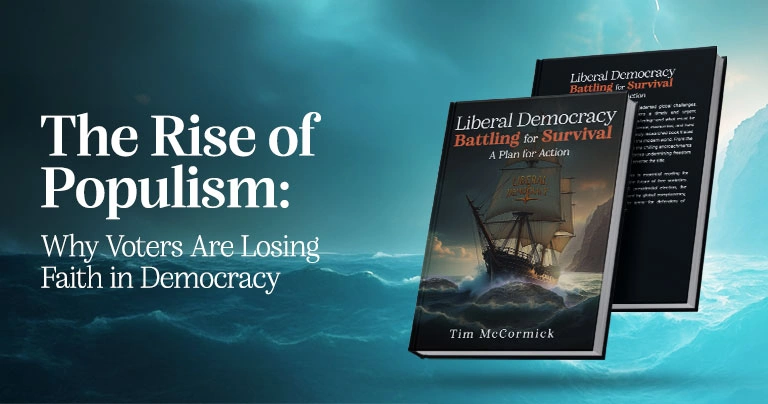
Tim McCormick’s Idea: Liberal Democracy Battling for Survival in the Age of Populism
Tim McCormick’s central argument is that populism is not an external enemy of liberal democracy but an internal consequence of its neglect. Liberal democracy, he argues, is “battling for survival” precisely because it has drifted away from its foundational purpose: protecting freedom, dignity, and basic human security for all citizens, not merely preserving electoral procedures.
In McCormick’s framework, populism emerges when democracy continues to function formally while failing substantively. Elections are held, institutions remain in place, and legal norms appear intact, yet large portions of the population experience democracy as distant, unfair, and unresponsive. Populism fills this vacuum by offering emotional clarity and moral simplicity where democracy has become technocratic and opaque.
Populism as a Democratic Warning Signal
McCormick does not treat populism as an irrational or purely extremist phenomenon. Instead, he presents it as a warning signal, evidence that democracy has lost the confidence of those it claims to represent.
According to McCormick:
People turn to populism not because they reject democracy in principle,
But because they believe democracy no longer protects them in practice.
Populist leaders succeed by articulating grievances that mainstream politics has ignored: economic insecurity, cultural displacement, loss of dignity, and the perception that elites operate above the law. In this sense, populism exposes democracy’s moral failure long before it threatens its institutional survival.
Populism as the Final Test Of Liberal Democracy
For Tim McCormick, populism represents the final stress test of liberal democracy. It reveals whether democracy is merely a system for managing power, or a moral project capable of adapting to human needs.
If democracy continues to prioritise markets over dignity, elites over citizens, and procedure over justice, populism will evolve into authoritarianism. But if democracy confronts its failures honestly, populism can catalyze renewal rather than collapse.
Liberal democracy is battling for survival not because populism exists, but because democracy has forgotten what it was meant to protect.
Causes of Populism
The following are the five ideal causes of populism in the world:
Economic Insecurity and Inequality
Populism thrives where economic systems generate growth without shared prosperity. When wages stagnate, costs rise, and social mobility stalls, citizens conclude that democracy no longer protects their material well-being. Inequality becomes political when people believe the rules favour elites regardless of electoral outcomes. Populist leaders convert this economic frustration into moral outrage by framing society as a struggle between “the people” and “the privileged.”
Democratic Disillusionment and Institutional Failure
Populism emerges when democratic institutions appear distant, unresponsive, or ineffective. Elections continue, but outcomes feel unchanged. Courts, parliaments, and bureaucracies are perceived as serving themselves rather than the public. This gap between democratic form and democratic substance creates fertile ground for leaders who promise to bypass institutions and “get things done.”
Loss of Dignity, Identity, and Cultural Recognition
Beyond economics, populism is driven by emotional and cultural displacement. Rapid social change in globalisation, migration, and shifting norms leaves many citizens feeling unseen or disrespected. Populist narratives restore a sense of dignity by validating grievance, offering belonging, and promising to reclaim a lost national or cultural identity.
Elite Detachment and Breakdown of Trust
When political corruption occurs, it leads to severe consequences. It is where the trust collapses as a result of wealth, networks, and privilege. Scandals, hypocrisy, and technocratic language reinforce the belief that leaders live in a separate moral universe. Populists succeed by presenting themselves as outsiders who speak plainly and reject elite norms, even when they later replicate elite behaviour.
Information Disorder and Emotional Mobilisation
Digital media environments amplify anger, fear, and grievance while weakening shared reality. Algorithms reward outrage over accuracy, fragmenting public discourse and eroding trust in traditional authorities. Populists exploit this emotional landscape by offering simple explanations, clear enemies, and constant mobilisation, turning democratic frustration into political loyalty. The idea of social media and democracy fails because of the spread of false information and the running of propaganda against the ruling government.
Conclusion: Populism as a Reckoning
The rise of populism did not happen overnight, nor did it emerge from nowhere. It grew in the soil of neglected grievances, widening inequality, cultural dislocation, and democratic complacency.
Democracy now faces a choice: reform or rupture. It can either evolve to meet the realities of a changing world, or continue losing legitimacy until stronger, less accountable systems take its place.
Faith in democracy is not restored by speeches or slogans. It is earned again and again through justice, competence, and care. Only a democracy that delivers in lived experience, not just in law, can withstand the populist tide.
Frequently Asked Questions
Populism is not inherently bad for democracy. It often begins as a legitimate response to democratic failure, highlighting inequality, exclusion, and unresponsive institutions. However, populism becomes harmful when leaders claim exclusive authority to represent “the people” and weaken democratic safeguards such as independent courts, free media, and minority rights. In this form, populism can transform democracy from a system of accountability into a system of loyalty.
Populism is rising because many citizens feel democracy no longer works for them. Economic insecurity, rising inequality, cultural dislocation, and political elites who seem detached from everyday realities have eroded trust. At the same time, social media amplifies anger and simplifies complex problems, making populist messages emotionally powerful and widely visible. Populism grows where democratic systems fail to deliver fairness, dignity, and meaningful participation.
Democratic backsliding occurs when elected leaders gradually weaken democratic institutions from within. Common causes include economic inequality, extreme political polarisation, populist leadership, attacks on independent media and courts, and public complacency. Backsliding often happens legally and incrementally, making it difficult to recognise until democratic norms are already damaged.
Misinformation undermines democracy by eroding shared reality. When citizens no longer agree on basic facts, democratic debate becomes impossible. Social media platforms accelerate the spread of false or misleading content by rewarding outrage and emotional engagement. This environment benefits populist actors, weakens trust in journalism and institutions, and increases political polarisation.
People distrust politicians when they perceive a gap between political promises and lived reality. Scandals, corruption, elite privilege, and technocratic language that ignores everyday struggles deepen this distrust. When politicians appear insulated from consequences or disconnected from ordinary life, citizens conclude that politics serves elites rather than the public.